SetupBarato
Compares hardware prices across 35 stores and tells you if today’s price is really good.
I built SetupBarato to answer the question a store page never does: is this price actually good? The site collects prices from 35 stores in rounds 90 minutes apart, keeps price history for its listings and uses that data to judge the price, build a compatible PC and tell you when it is worth buying.
- Role
- Creator and developer: product, data collection, backend, front-end, browser extension and infrastructure
- Live since
- Jun 2026
- Stack
- Next.js, TypeScript, PostgreSQL, Tailwind CSS, Docker, Cloudflare, Web Push
- products tracked
- ~95k
- active stores
- 35
- in-stock offers with fresh prices
- 60k+
- between collection rounds
- 90 min
01SetupBarato
The problem
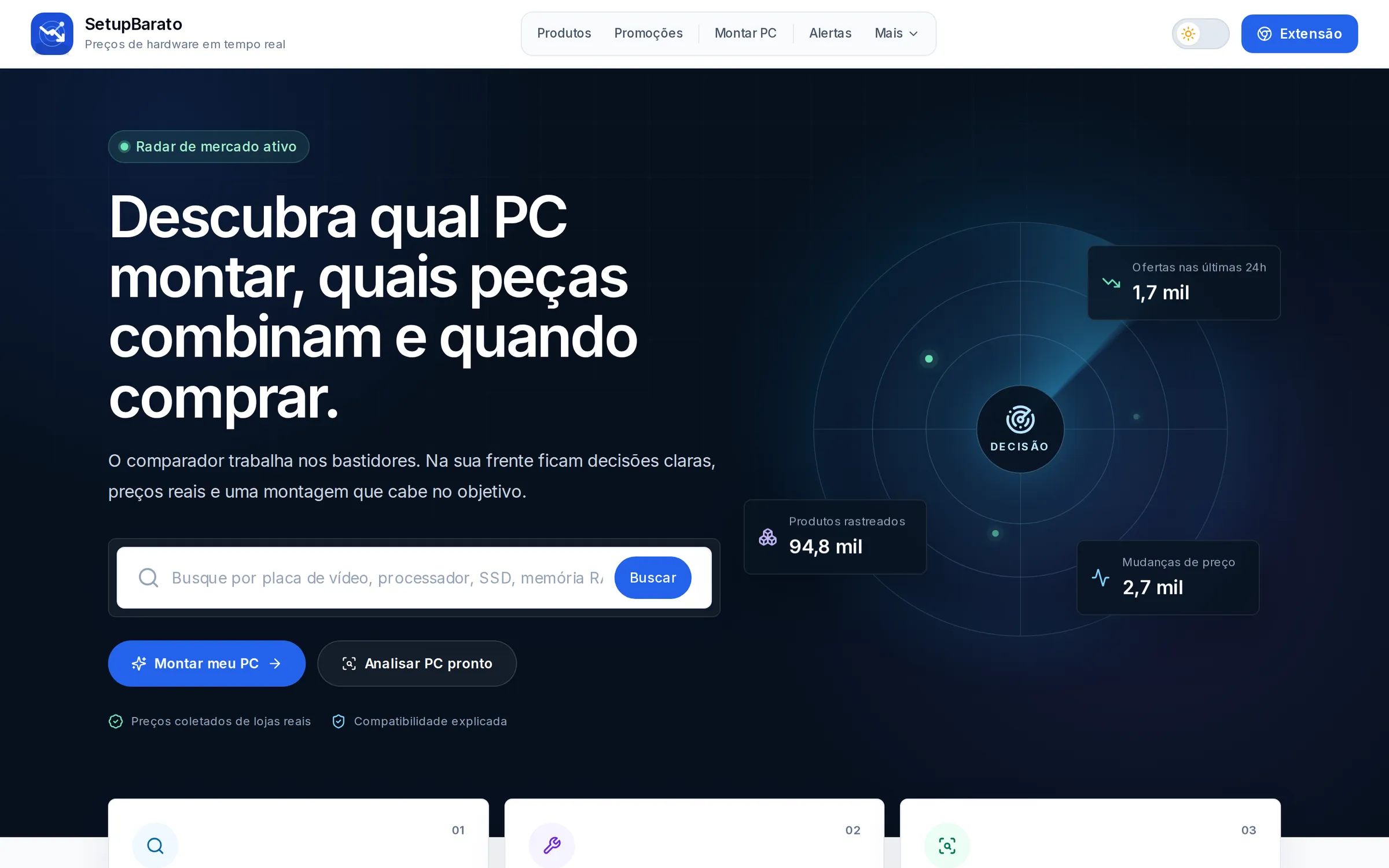
Hardware buyers in Brazil have dozens of stores to check, and the same item shows up in several of them with different prices and installment plans. Comparing by hand takes time and goes stale fast: in the last 24 hours alone, the radar logged 2.7k price changes.
The store’s “was/now” pricing doesn’t help either. The struck-through “De R$” price may be one the product hasn’t sold at in months, and without history there is no way to tell whether the discount is real.
And price is only half the problem. A cheap part may not fit the rest of the build, or may become the bottleneck. As the site puts it: a cheap PC starts with what you will use it for, not with the part on sale.
02SetupBarato
What it does
Cross-store comparison
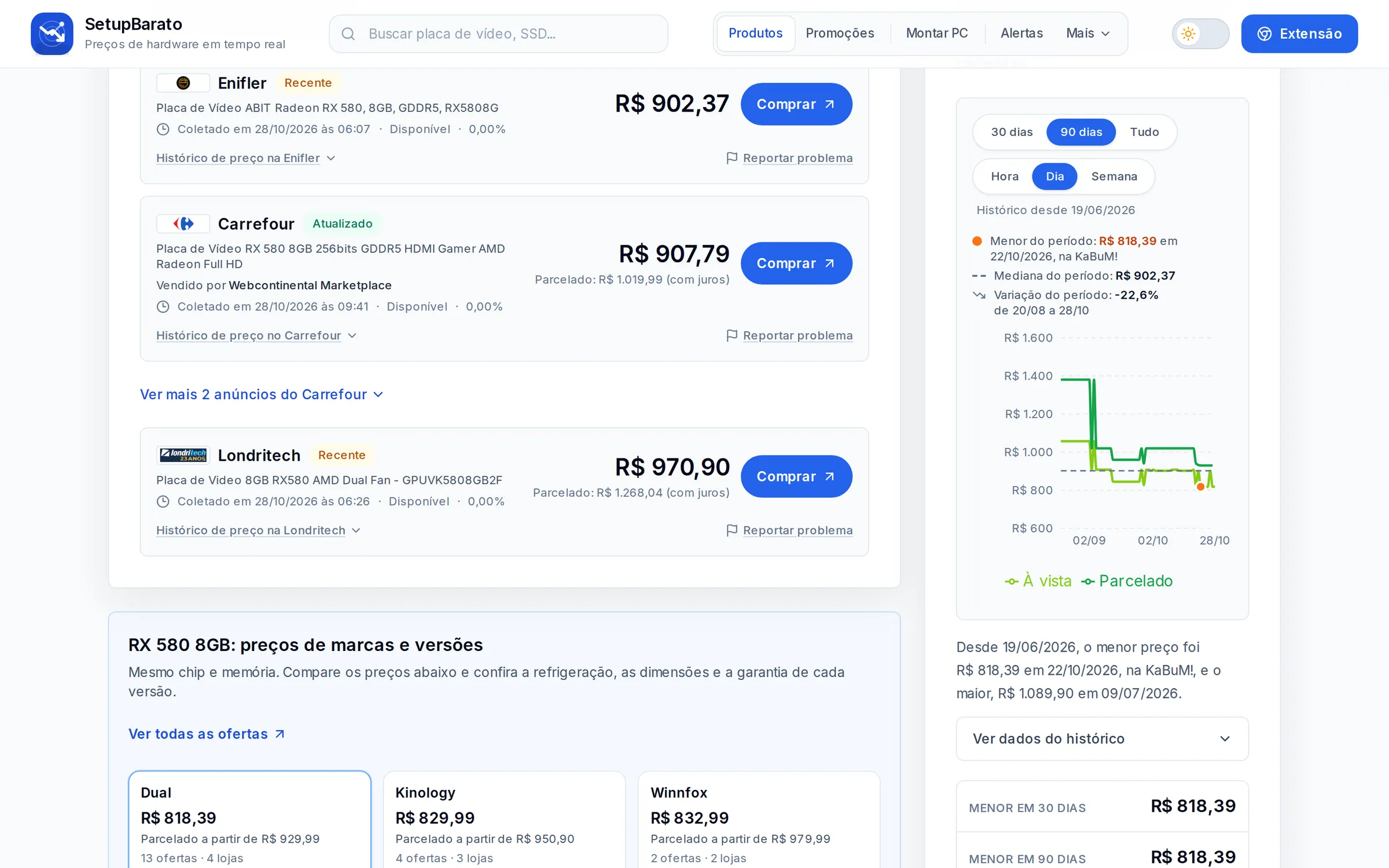
The same item is shown side by side across every store with a safe match, cheapest available offer first. Each price shows the date and time it was collected.
Price history and verdict
Charts per listing and per model, from 30 days to all time, with separate cash and installment lines. A badge says whether the price is good, normal or expensive against the last 90 days.
AI-assisted PC builder
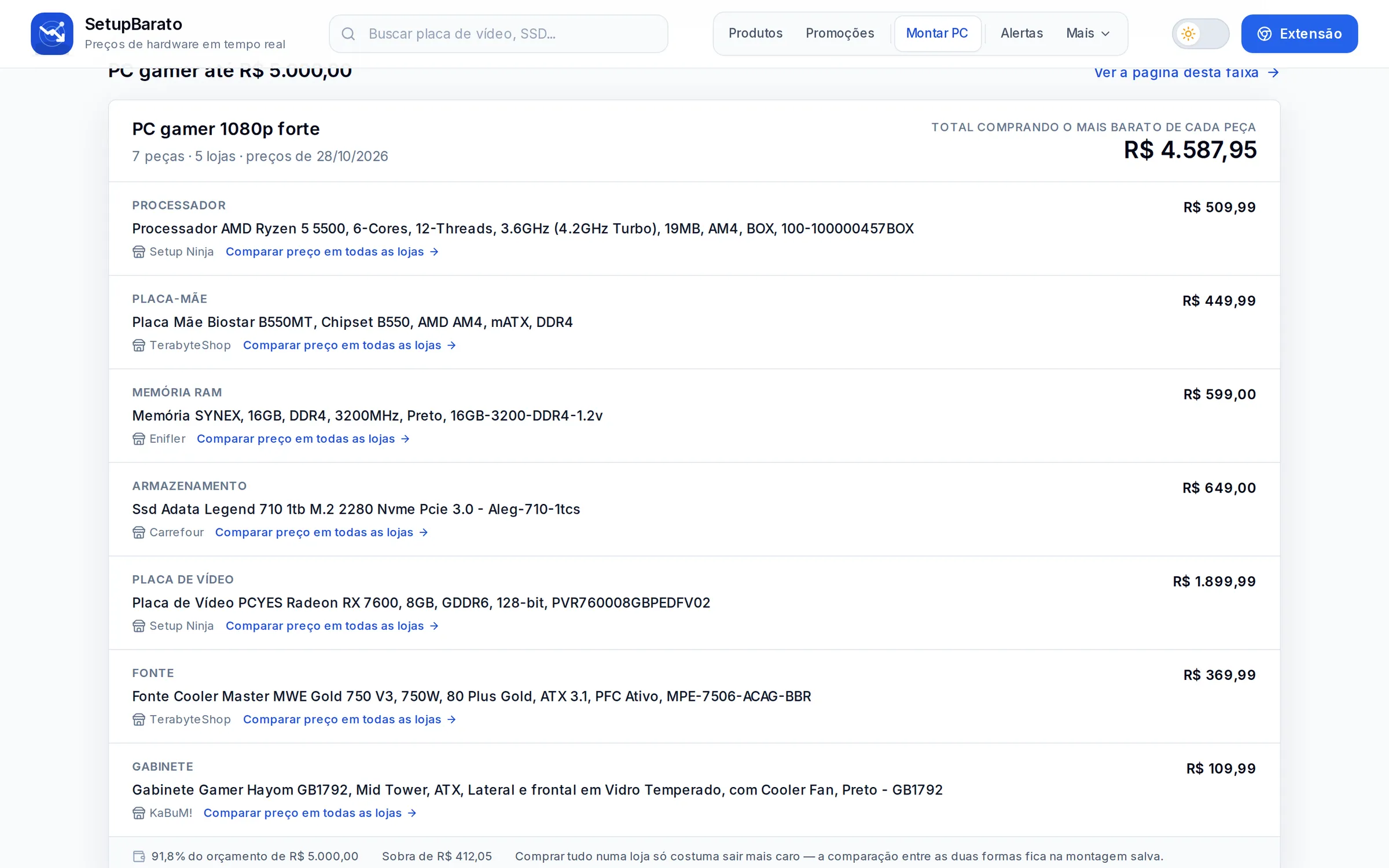
You describe the use and the budget and get a compatible build priced from the live catalog, with socket, DDR generation, motherboard and case form factor and PSU wattage checked. For 16 games it shows FPS ranges and says plainly when a number is an estimate, not a measurement.
Prebuilt PC check
Breaks a prebuilt PC listing into parts and compares its price with the estimated cost of building an equivalent set. Pasting a Pichau, TerabyteShop or Shopee link starts tracking it.
Chrome and Edge extension
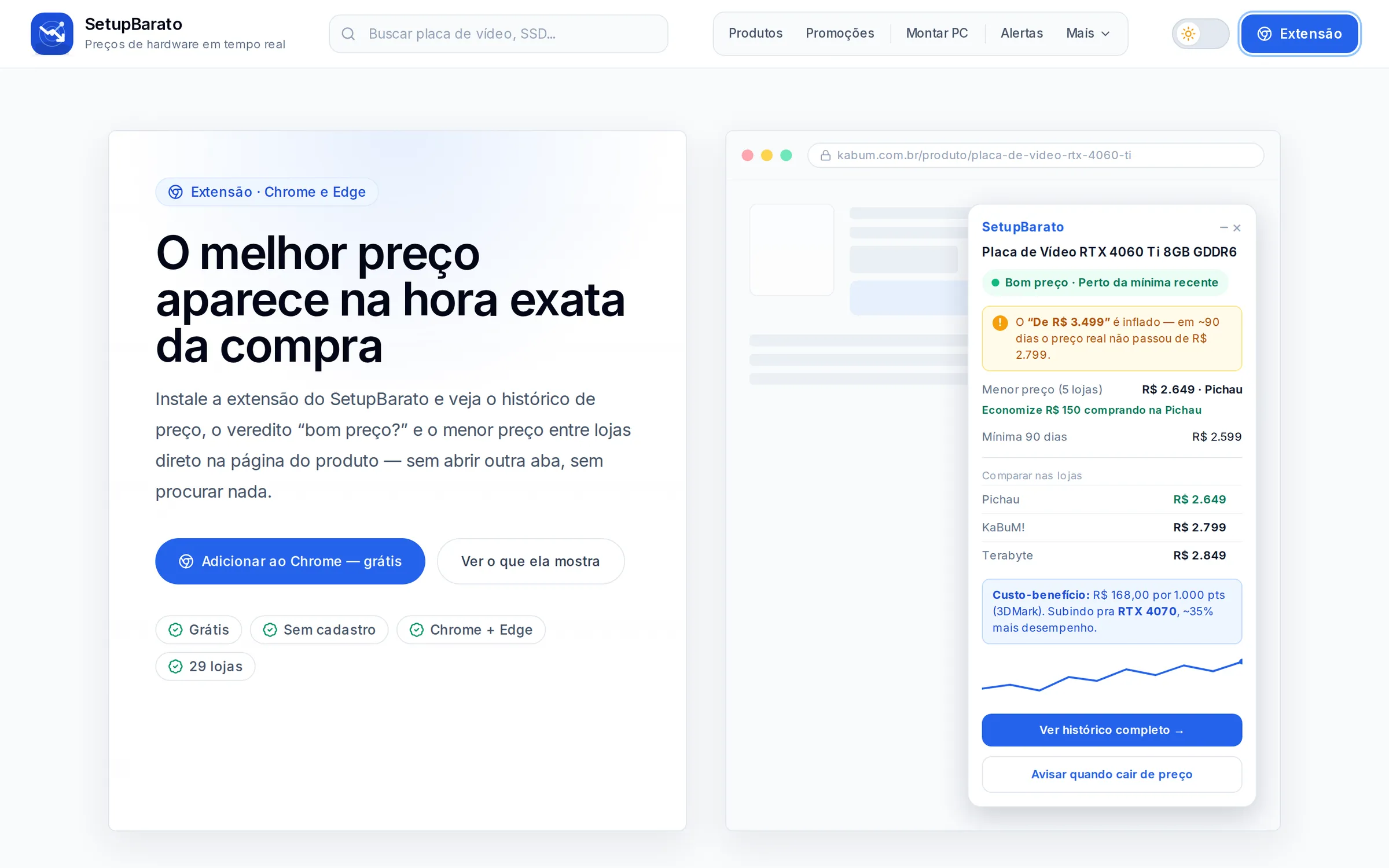
Adds a card to the store’s product page with the verdict, an inflated “De R$” warning, the cheapest store and the 90-day low. It renders in Shadow DOM and, unless you set an alert, only the product URL and title leave the browser.
Value rankings and price index
GPU and CPU rankings in R$ per 1,000 PassMark points, plus a weekly price index across 6 hardware categories.
03SetupBarato
How it works
Collection
Prices come from each store’s product page or official API, in rounds: when one ends, the next starts 90 minutes later. Each offer yields the cash price, the installment price when the store lists one, and stock status.
Filtering
Used, refurbished and open-box listings are dropped by title, and offers unconfirmed for more than 3 days leave the comparison. A price 10x above or below the listing’s own median is treated as a catalog error.
Matching
Each listing is tied to its model, such as “RX 580 8GB”, with brands and versions kept apart. When a listing lands on the wrong product, “Reportar problema” takes a “different product or version” report.
History
Collected prices build each listing’s history; on the model page, the series is the lowest price of the day across stores. Amazon is the exception: its affiliate program rules keep its prices out of the history.
Verdict
Today’s price is checked against the last 90 days: “Bom preço” (good price) up to 8% above the low, “Caro” (expensive) more than 8% above the median, and “Sem base” (no baseline) with fewer than 5 data points.
Alerts
With no account, alerts arrive as browser notifications; by email (6-digit code, no password) or on Telegram, they also fire when a product is back in stock. For models sold in several stores, one alert can watch all of them and point to the cheapest offer.
04SetupBarato
Engineering decisions
Not enough history, no verdict
The price badge only appears with at least 5 data points in the last 90 days; below that, the offer is marked “Sem base” (no baseline). The “lowest since…” badge asks for more: 60 days of history and more than 2% variation, because a price that never moves is always “at its lowest”. New listings go without a badge for a while, but no badge claims more than the data supports.
The median decides, not the spike
“Caro” (expensive) means more than 8% above the 90-day median, so a flash sale or an isolated spike can’t drag the reference around. A price 10x above or below the listing’s own median is treated as a catalog error and kept out of the chart and the badge. The trade-off is that a real shift in price level takes longer to show up in the median.
A price without a timestamp is not a price
Every offer shows the date and time of its last collection. An offer the collector hasn’t confirmed in more than 3 days drops out of search, comparisons and listings, so an old price never passes for today’s. Comparisons lose offers when a store falls behind, but whatever is shown is fresh.
The store’s rules come before a complete chart
The Amazon Associates Program doesn’t allow storing its prices for more than 24 hours or using them in history or alerts. So Amazon joins comparisons with its current price but gets no chart, badge or alert, and drops out of search if it isn’t collected again within 24 hours. It is the store with the most tracked offers, 26.2k, and still gets the simplest version of the product.
Stable recommendations beat the newest benchmark
For graphics cards, the PC builder uses its own gaming performance index, frozen at its June 29, 2026 values, instead of following every new PassMark snapshot. The same question doesn’t get a different build just because a score moved. The cost is that the builder’s index doesn’t pick up new measurements on its own.
05SetupBarato
By the numbers
- products tracked
- ~95k
- 94.8k on the homepage and 94,767 on the status page.
- active stores
- 35
- From large marketplaces to specialist hardware stores.
- in-stock offers with fresh prices
- 60k+
- From the “how it works” page: 60,833 to 60,878 on the morning of the reading. Used, out-of-stock and stale offers are excluded.
- between collection rounds
- 90 min
- The next round starts 90 minutes after the previous one ends.
- price changes in 24 hours
- 2.7k
- Homepage counter.
- URLs in the sitemaps
- 34k+
- 13,827 model pages and 20,251 product pages, counted from sitemap.xml.
- models in the weekly index
- 2,090
- Models sold in 2 or more stores, across 6 categories.
Public numbers from the live site, as of October 28, 2026.
06SetupBarato
Screens